
Over the years as an accountant working with self-employed clients across Canada, one question keeps coming up:
“What tax mistakes should I avoid as a freelancer or entrepreneur?”
The truth is, even the most organized business owners can overlook key details that lead to unexpected penalties, audits, or lost tax savings.
In this article, I’ll walk you through some of the most common and some not so obvious mistakes self-employed individuals make when filing taxes in Canada. More importantly, I’ll share practical solutions to help you stay on track, reduce stress, and keep more of your hard-earned income.
Common Mistakes When Filing Taxes (Self-Employed in Canada)
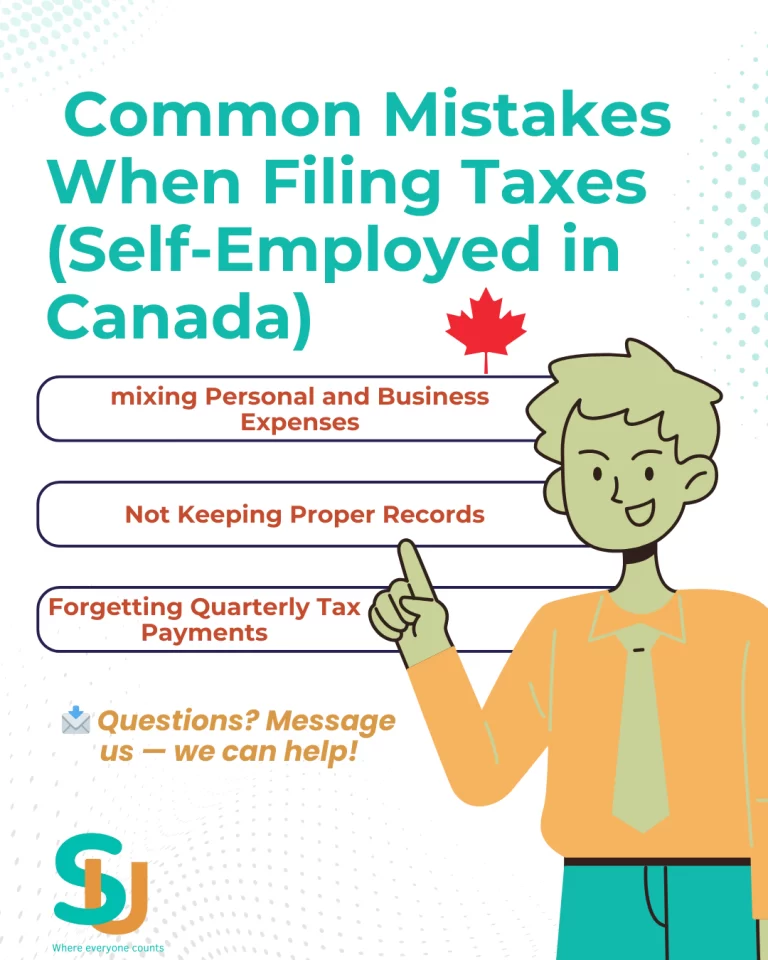
When clients ask me about tax mistakes, these are the ones I hear most often. In some cases, the solution is simple. In others, it takes a bit of investigation and strategy.
But don’t worry below, I’ve laid out the most common mistakes I see as an accountant, along with practical solutions, all in a simple, easy to read format.
Let’s dive in.
📦 Mistake 1: Mixing Personal and Business Expenses
Why it’s a problem: It confuses your bookkeeping, makes tax prep harder, and could raise red flags with the CRA.
✅ Solution: Open a dedicated business bank account and credit card. Keep business transactions separate from personal spending.
📦 Mistake 2: Not Keeping Proper Records
Why it’s a problem: If audited, missing receipts or invoices can lead to denied claims and penalties.
✅ Solution: Keep digital copies of receipts, invoices, and mileage logs. Use apps or folders organized by category. CRA requires record retention for at least 6 years.
📦 Mistake 3: Forgetting Quarterly Tax Payments
Why it’s a problem: If you owe over $3,000 in taxes, CRA expects quarterly installments. Missing them can lead to interest and penalties.
✅ Solution: Estimate your taxes and pay quarterly (March 15, June 15, Sept 15, Dec 15). Track and pay through CRA MyAccount.
📦 Mistake 4: Not Claiming All Eligible Deductions
Why it’s a problem: Missing valid deductions like home office or subscriptions means you pay more tax.
✅ Solution: Track all business-related expenses: home office, software, internet, mileage, supplies, accountant fees even small amounts add up.
Uncommon Tax Mistakes for the Self-Employed in Canada
These aren’t the first things self-employed people usually ask me about but they can still lead to costly problems. Less common mistakes are often overlooked, and because of that, they can go unnoticed for years until it’s too late.
In this section, I’ll walk you through a few mistakes that may seem minor, but have real financial consequences and how to fix them before they become a headache
📦 Mistake 1: Not Charging HST When Required
Why it’s a problem: Once you pass $30,000 in revenue over four consecutive quarters, you are legally required to register for HST. Failing to do so can lead to CRA penalties and back-dated taxes owed.
✅ Solution: Monitor your income monthly. Register in advance if you're close to the threshold. You can even register early to claim input tax credits.
📦 Mistake 2: Not Structuring How You Pay Yourself
Why it’s a problem: If you’re incorporated, transferring money to yourself without classifying it properly (salary, dividends, or shareholder loan) can result in incorrect tax filings.
✅ Solution: Work with an accountant to set up the correct payment method. Be sure to issue the proper slips (T4, T5) and keep records of board approvals or remittances.
📦 Mistake 3: Not Saving for CPP Contributions
Why it’s a problem: As a self-employed person, you’re responsible for both the employee and employer portions of CPP. This often surprises people when they see their tax bill.
✅ Solution: Estimate your CPP liability during the year and include it in your tax savings. Use a calculator or ask your accountant to include it in your remittance plan.
📦 Mistake 4: Ignoring Foreign Income or Platforms
Why it’s a problem: Many freelancers forget to report income earned through platforms like Upwork, Etsy, or U.S.-based clients. Even if the money isn’t sent directly to a Canadian bank, it must be declared.
✅ Solution: Track all sources of income, including international clients and platforms. Report them on your Canadian return, and check if foreign tax credits apply.
In the cards above, we covered some of the most common (and overlooked) tax mistakes that self-employed individuals in Canada make.
But every business is different and tax rules can get complicated fast.
If you still have questions about your specific situation, I offer a free 15-minute consultation to help you get clear on your next steps.
Click the button below to book your call I’ll be happy to help!