
Independent work is booming in Canada. Whether you’re a designer, consultant, or software developer, choosing the right tax setup is crucial to keep more of what you earn. Should you operate as a freelancer or incorporate your business?
With 2025 tax laws and benefits in mind, this guide breaks down the pros and cons of each structure to help you make an informed financial decision.
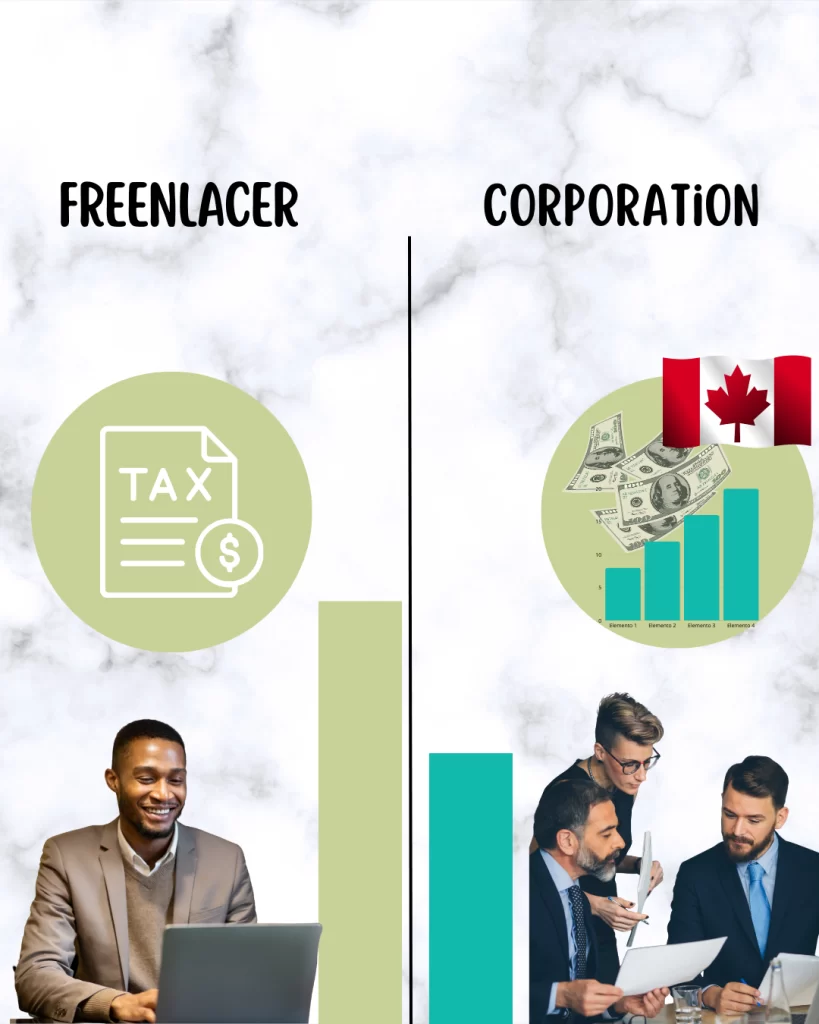
What’s the Difference?
Freelancer (Sole Proprietor):
You run your business under your personal name. Income and expenses are reported on your personal tax return (T1).
Corporation (Incorporated Business):
A separate legal entity. It files its own taxes (T2). You can pay yourself a salary or dividends.
Tax Benefits of Being a Freelancer
✅ Simple and low-cost setup.
✅ No legal registration required.
✅ You report all income/expenses on your personal return.
✅ Fewer reporting obligations (no T2, unless HST/GST applies).
✅ Great if you earn under $50,000/year
Drawbacks of Freelancing
❌ Higher personal income tax rates (up to 53% in some provinces).
❌ No tax deferral or income-splitting strategies.
❌ Unlimited personal liability — you’re fully responsible for business debts or lawsuits.
Tax Benefits of Incorporating
✅ Access to the small business tax rate (~9% federally, plus provincial).
✅ You can defer tax by leaving money in the business.
✅ Flexibility: pay yourself via salary, dividends, or both.
✅ Limited legal liability — protects your personal assets.
✅ Greater credibility with banks and clients.
Drawbacks of Incorporating
❌ Setup and maintenance costs ($800–$2,000+ per year).
❌ You must file a separate corporate return (T2).
❌ Requires more complex bookkeeping, payroll setup, and compliance.
❌ Not tax-efficient if you withdraw all earnings immediately.
When Should You Incorporate?
| Annual Net Income | Best Option |
|---|---|
| < $50,000 | Stay a Freelancer |
| $50,000 – $100,000 | Consider Incorporating |
| > $100,000 | Incorporating is Usually Better |
Tax Comparison Table Freelancer vs Corporation
| Feature | Freelancer | Corporation |
|---|---|---|
| Tax Rate | 20–53% (personal) | 9–15% + dividend tax |
| Admin Costs | Low | High |
| Legal Protection | None | Yes |
| Tax Deferral | No | Yes |
| Flexibility | No | Yes |
| Filing Requirements | T1 only | T2 + payroll/HST |
Frequently Asked Questions (FAQ)
How much should I earn to incorporate?
Generally, if you’re making over $80,000 in net income annually, it may be time to consider incorporating.
Can I just pay myself dividends?
Yes — you can choose to pay dividends, salary, or a combination, depending on your tax strategy.
.
Can freelancers write off expenses?
Absolutely! Common deductions include home office, software, internet, equipment, and travel.
Will I always save more tax by incorporating?
Not necessarily. It depends on how much income you retain in the company and your personal tax bracket.
Can I go back to freelancing after incorporating?
Yes, but you’ll need to formally dissolve your corporation with CRA and your province..
Final Thoughts: Choosing the Right Path for Your Business
Choosing between freelancing and incorporation is a major step in your entrepreneurial journey. For some, the simplicity of sole proprietorship is ideal. For others, the tax planning and protection that incorporation offers make it the smarter path.
Evaluate your income, growth goals, and risk exposure and talk to a qualified accountant before deciding.